
by
Denise
McCluggage
Luxury
and aluminum.
The "u"s and "l"s slide in mellifluous
serenity ending in a hum. Lovely sound.
 But
the words have meanings as well and who would have thought that
the stuff of beer cans could be compatible with sumptuousness,
opulence, magnificence? But
the words have meanings as well and who would have thought that
the stuff of beer cans could be compatible with sumptuousness,
opulence, magnificence?
Two
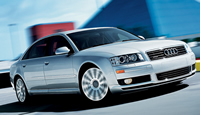
makers of fine automobiles think so. Several years ago Audi for its flagship A8
became the first to use an aluminum space frame. The new 2004 Audi A8 L amplifies
(and simplifies) that use of aluminum. 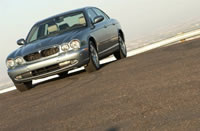 A
new approach to aluminum use (or aluMINium in this case) is found in another redone
flagship: the Jaguar XJ8. This is not a space frame but a monocoque configuration
more like the fuselage of an airplane and using aircraft technology in riveting
and bonding. It makes for snug, quiet rigidity. A
new approach to aluminum use (or aluMINium in this case) is found in another redone
flagship: the Jaguar XJ8. This is not a space frame but a monocoque configuration
more like the fuselage of an airplane and using aircraft technology in riveting
and bonding. It makes for snug, quiet rigidity.
Both
manufacturers like aluminum because of its great saving in weight and the gain
in torsional rigidity (something around 60% more than in a similar steel-bodied
car.) The weight saved translates into improved gas mileage, of course, but that
is not the first consideration in V-8 driven posh-mobiles; lighter beginnings
means more luxurious amenities can be included in the package without larding
up. Brief
reviews of both cars follow. Suffice it to say both - bigger and stronger than
the cars they replace - represent a definite progression into ever finer transport.
Both have a high WOW quotient in appearance and in performance.
Beer
cans really clean up nice.
 The
2004 JAGUAR XJ8: The
2004 JAGUAR XJ8:
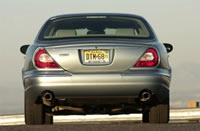
Still handsome and still clearly a Jaguar the
new XJ has lost the distinctive drooping tail section. Indeed the back end of
the car rises a bit. Those who like the idea of lugging the equipage of a full
foursome of golfers will like it fine.
And
those taller than the nation's norm will appreciate the higher roofline and generally
greater spaciousness of the interior. (Two inches more legroom in front for a
start.) Drivers
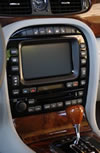
will be pleased with their quarters. It's as if Jaguar invented supple leather
teamed with burl maple (real, if it needs saying.) But something else Jaguar might
have invented is absent in this cockpit: confusion of controls. In this car everything
seems to be in its destined place, clearly apparent and easy to get at.
And
you'll love the readability of the seven-inch screen in the
center console where the navigation system dwells. It is also
command central for heat and cool and sound. Don't fidget -
it is transparently easy to use.
 The
new XJ headed stateside wears a 4.3-liter V-8 engine. (No six-cylinder will come
to the US.) This V-8 was introduced in the 2002 S-type last year and is used in
the XK coupes. It produces nearly 300 hp (294) and 303 pound-feet of torque. Which
makes for a nice launch when acceleration is called for. Merge quickly, pass with
alacrity: it works just fine. The
new XJ headed stateside wears a 4.3-liter V-8 engine. (No six-cylinder will come
to the US.) This V-8 was introduced in the 2002 S-type last year and is used in
the XK coupes. It produces nearly 300 hp (294) and 303 pound-feet of torque. Which
makes for a nice launch when acceleration is called for. Merge quickly, pass with
alacrity: it works just fine.
The
transmission is a six-speed automatic with no manual available even in the XJ8
R, which is the supercharged version. The XJ8 engine is likely to get you to 60
from a standstill in 6.3 seconds and will top out at 121 mph (purposely limited).
They let the R carry on to 155 mph.
Three
XJ models will arrive here, the XJ8, the dandier Vanden Plas and the R. The Vanden
Plas, befitting its uppity name, is uppity-er and costs more ($68,330 to $59,330
for the XJ8 - plus destination charges). The R is $74,330.
The
two normally aspirated models (i.e. without a supercharger) are rated for 28 miles
per gallon on the highway. Gotta admit that's impressive for a powerful V-8.
Driving
the XJ8 is as pleasurable as it should be in something that looks so good and
goes so well. Some drivers might find the steering a little light, but then others
might like it for that very reason. The air suspension system keeps the wheels
following the road's surface without transmitting the details of every hole and
hollow to the passengers. The driver likes the control of knowing the tires are
familiar with the road and the passengers like the silky flow of progress.
Of
course there's all that tech-y stuff that helps keeps the car pointed in the chosen
direction and avoids wheel slippage and tail wagging when the surface is slippery.
The
times are past when owners loved their Jaguar so much they visited it at least
twice a week in the shop. Jaguar is now rated above average in the J.D. Power
Initial Quality survey and ranks ninth in the world. It has, under Ford, made
some commendable advances in reliability and build quality without losing its
unique and appealing "Jaguar-ness". The XJ8 continues the progress.
And the delight.
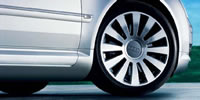 The
2004 Audi A8 L quattro: The
2004 Audi A8 L quattro:
"L" stand for Long, as in wheelbase.
A longer wheelbase means smoother cruising on uneven surfaces and for tall folks
in the cushy backseat it means cross-legged riding comfort. The L is the only
A8 to come to the US. As an S8 the shorter wheelbase will follow sometime hence.
With
this new, larger, more self-confident A8 I would say Audi now tops the charts
of the German luxury sedans. Yes. I would choose it over the Mercedes S-Class
or the BMW 7 Series. You may not agree, but you would be remiss - nay, a fool
- not to include it in your shopping plans.
Long
is truly long - 17 feet. Nothing like a little size to lend a car presence. And
nothing like spacious rear quarters (where the additional length has gone) to
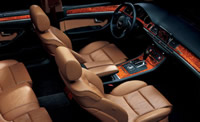
communicate earnest luxury. But then Audi interiors are consistently superior.
They either wrap passengers in serene order or spice the day with appropriate
wit (thinking TT here.)
But
oddly in driving the A8 L one wonders where the mass went. The car hustles along
youthfully, spurred by the smooth 330-horsepower V-8 (and in just 6.3 seconds
after planting your right foot you will be at 60 mph).
This
A8 has a six-speed (up from five) automatic transmission. With Tiptronic for those
who like to toy with the gearshift lever. The six-step gearing allows for more
oomph at the low end for those prompt off-the-line launches Americans crave.
But
ultimately it's the responsive steering and handling that makes a driver believe
that Honey, someone shrank the Audi. It is nimble, responsive and even taut. Nice
short turning circle, too, for something of this dimension. OK, so not as crisp
like a BMW M3 (what is?) or maybe even the 7 series, but all present and accountable.
Feels cream rich.
 So
grant the pleasing aesthetics of the Audi, the technology is also impressive but
never overwhelming as it can be in BMW's 7 series. If you were contemplating a
summer session at a nearby tech institute just so you could shop for a luxury
vehicle, relax. All you need to deal with heating and cooling and navigating and
selecting music is your intuition and perhaps an edifying run-through of the owner's
manual. No iDrive 101a required. So
grant the pleasing aesthetics of the Audi, the technology is also impressive but
never overwhelming as it can be in BMW's 7 series. If you were contemplating a
summer session at a nearby tech institute just so you could shop for a luxury
vehicle, relax. All you need to deal with heating and cooling and navigating and
selecting music is your intuition and perhaps an edifying run-through of the owner's
manual. No iDrive 101a required.
MMI
for "multimedia interface" is the Audi system and is the best I've experienced
thus far. I also like the screen that pops up like done toast in the center of
the instrument panel. If it's tucked away, a small screen amid the instruments
smack in front of the driver carries the same information.
Trust
me: it all works as slick as wet soap thanks to duplication, feedback and an "undo"
capability that, mysteriously, many systems lack.
By
the way, this Audi offers a choice of either of the satellite radio sytems - the
XM or Sirius. That's a first.
The
A8's aluminum space frame in its second generation version has been modified for
greater simplicity and even more rigidity. But to really matter a rigid chassis
has to be teamed with the right suspension system and this A8 L gets an all-new
air-suspension that works admirably.
The
driver can raise or lower the suspension to match the needs of the moment. High
interstate speeds, deep snow or a sinuous byway that plays between the trees.
Press a button and all is done electrically and microseconds quickly. The "Comfort"
setting, for instance, will smooth out a pockmarked road, but still maintain contact
with the surface. "Dynamic" instructs the system to hunker the car lower
to the road when topping 75 mph.
The
A8 L takes advantage of the weight aluminum saves by packing on goodies galore.
And remember, because it is a "quattro" it boasts a time-tested all-wheel-drive
that makes for more secure motoring on either wet or dry surfaces. The Audi A8
L is priced at $68,500.
Click here for more information on the Audi A8 L.
Click here for more information on the Jaguar XJ8.
For the Audi 2004 Model Guide : Click
Here
For the Jaguar 2004 Model Guide : Click Here
|