| 
by
Amanda Castleman
The
hymn pipes out at dawn from the golden tower, as the Magdalen
Boy's Choir welcomes spring to Oxford, England. The innocent
soprano voices melt into the morning sky, as thousands of
revellers fall silent below.
Many
wear elegant ball gowns and tuxedos, rumpled from a riotous night of drink and
dancing at a college ball. Some sport carnival costumes: fairy wings, masks, trailing
ivy wreaths, togas, smears and sprinkles of glitter. Others appear bundled up,
still bleary from bed, but game - even at six in the morning. "Te
adoramus, O Jesu," the boys carol in Latin, high pure voices trailing like
river mist 144 feet above the crowd. A fellow of Magdalen College, part of the
hallowed Oxford University, wrote the Hymnus Eucharisticus in the late 18th century.
But the tradition stretches back much farther: In 1650, the city summoned Spring
at the early-bird hour of 4.00am. Enthusiasm
for this ancient tradition was revived by Richard Attenborough's 1993 film Shadowlands,
which depicted the bittersweet romance between children's author and scholar C.S.
Lewis and his cancer-striken wife Joy. Over 11,000 people gather each year on
May 1st, unperturbed by the event's blithe mix of cassocked choir boys and fertility
rituals; mystical music and drunken carnage. 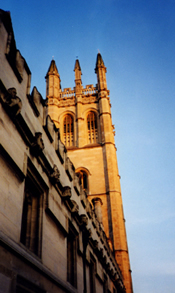 | Magdalen
Tower |
Victorian
artist William Holman Hunt emphasised the ethereal side of the event in his often-reproduced
May Morning on Magdalen Tower. He omitted the tipsy undergraduates and their "youthful
frolic", adding a mass of blossoms and, quite curiously, a Persian sun worshipper.
Changes aside, the flowing painting captures the simple beauty of this festival.
Real-life
doesn't censor the frolic, however, and the crowd usually manages some mild hijinks.
After all, May Morning misbehavior is a time-honored tradition. "Magdalen
College men and the rabble of the towns came on May Day to their disturbance,"
complained a 16th-century local. Two hundred years later, spectators were regularly
pelted with rotten eggs and other unpleasant missiles.
Today, revellers are more likely to strip naked and jump screeching into the river. A sozzled undergraduate first took the plunge 13 years ago. Others followed suit, including - most famously - student Jocelyn Witchard in 1995. She made a second topless splash in The Sun, a tabloid which paid her £1,000 for a Page Three pin-up photo.
Structural problems led officials to barricade the bridge on May morning from 1998-2001. The bulging and heaving crowds weakened the stone parapet of the historical structure, designed by John Gwynn in 1773.
Now the bridge is secure, re-enforced by steel anchors, but The Thames Valley Police still discourage leapers. Twenty-two people were injured, some seriously, after jumping into the four-foot-deep Cherwell River in 1994. A few years later, a male student dived off the parapet and suffered serious spinal injuries, which left him confined to a wheelchair.
Luckily, there's plenty of opportunity for colourful self-expression without skinny-dipping in a grubby stream. When the choir's last fluting note fades, ten bells toll and the blinking clot of people begins shuffling up High Street, past the densest patch of Gothic architecture in the world, the ornate domes, spires, turrets and gargoyles of Oxford.
Policemen on prancing horses herd them along. "Move along now, people. That's it. Go have a nice quiet pint," they cry. Many revellers do split off into the pubs - open by special dispensation - washing back mugs of lager and stout. Others opt for a proper artery-clogging English breakfast; eggs, beans, sausage, fried tomatoes and mushrooms, all soaking into fried bread and chips (fries - aka freedom or French, depending on your war stance).
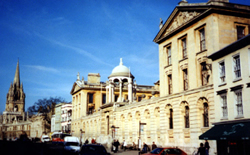 |
Oxford High Street |
Oxford's city centre is mobbed with maypoles, street theatre, baroque music, jazz, barber-shop quartets, Punch and Judy skits, parade floats and mobile discos. A paper machê unicorn puppet frolics, plunging its horn through a rose-festooned hoop, as the audience hoots bawdy innuendos. A woman slices into a phallus-shaped cake, pressing frosting-smeared slices on timid revellers. And the Morris Men are everywhere, stamping and jingling and shouting.
These folk dancers wear vests swirling with patches and buttons, jaunty caps and clogs. Some strap bells down their shins, others flourish hankies. One especially rowdy routine involves the fierce clash of clubs. A women's troupe - a historical oddity, but welcome in these PC times - reinterprets this number, punctuating the clatter of wood with high-pitched yips. The females of the species seem far more dangerous than the beer-swilling, bearded males, whose cheeks glow ham pink in the early light.
Another group pegs around a capering tree, which bumbles blindly on its leash. The person inside is completely obscured by evergreen bows, arms and legs bound tight under the greenery. A maiden is selected from the crowd - a country girl in cheap pastels - and pushed into the ring. Each Morris Man circles in for a peck on the cheek. She giggles and blushes.
The pine demands its due and flounders towards the lass. The crowd goes wild, cheering. "Tree, tree, give us a hug," sings a pack of undergraduates hanging off the wrought-iron library fence. Everyone takes up the chant: "Tree, give us a kiss! Treeeeee!"
Enthusiasts trace Morris dancing back hundreds of years to pagan fertility rituals (easy to believe as the lecherous tree corners the cooing girl: the scene isn't exactly subtle). But scholars suspect a liberal amount of "reconstruction" went on in the 19th century. Whatever the source, Oxonians have made the vibrant tradition their own. And like the whole of May morning, it's a little bit naughty, a little bit nice - and utterly charming.
| May Morning Tips |
A low-key alternative celebration began in 1989 on Aristotle Bridge in Jericho, the old factory neighbourhood near city centre. Oxford sculptor Michael Black built a 20ft-high replica of the tower to escape the raucous downtown crowds. The event continues, although police have cracked down on illegal raves in nearby Port Meadow and Shotover Country Park.
If you're still moving by mid-morning, work off the champagne buzz on the river. Rent a punt, a small flat boat propelled by a pole (Oxford's answer to gondolas). Locals typically bring along a picnic hamper crammed with delicacies and wine bottles.
True romantics wear white flannel and boater hats a la Brideshead Revisited (but usually return crumpled and muddy). Cherwell River etiquette demands that punters turn a blind eye to Parson's Pleasure, a stretch where gentlemen sometimes sunbathe nude (M-F £9 per hour, weekends £10 per hour. Deposit £20 plus ID. Open March-November 10am-9pm. Magdalen Bridge Boat Company; Magdalen Bridge, near the ice cream kiosk; 01865. 202.643). |
| Oxford Travel Directory |
Transport
Oxford and the capital are linked by 24-hour express buses. Both companies run between London Victoria and Gloucester Green. Many locals prefer Citylink's X90 service, which stops at Baker Street (www.oxfordbus.co.uk), though the Oxford Tube boasts on-board toilets (disabled access 01865.772250; www.stagecoach-oxford.co.uk). Day return £10, period return £12. The trip takes 90 minutes, unless mired in commuter traffic.
Train fares are much steeper (£14.80 day return, rising to a ridiculous £40 during peak periods). Without changes, it's roughly an hour from London Paddington to Oxford's station on Botley Road.
Cars are a liability in downtown Oxford, a medieval maze of one-way streets with limited parking. Leave your auto on the outskirts at the Park and Ride lots, then hop a bus into town. Cab companies include Radio Taxi (01865.242424) and ABC (01865.770681)
Where to stay
Budget
The cheap and cheerful Backpackers' Hostel offers beds from £11 (a bargain - and downtown to boot, unlike the remote YHA location). The scene is young, insistent and loud. In fact, the management promotes its "bar famous for late nights and table dancing". Single and mixed-sex dorms; 92 beds; no curfew; kitchen; laundry; Internet; luggage storage; pool table (9a Hythe Bridge Street; 01865.721761; www.hostels.co.uk).
A cheaper - and calmer - option is Oxford Camping and Caravanning (RV), behind the Touchwoods outdoor shop (£3.80-5.00 per person). Toilet and laundry facilities, good bus connections into Oxford proper (426 Abingdon Road; 01865.244088).
Moderate
The River Hotel nestles on the bank of the Thames by Osney Bridge, a ten-minute walk from the city center. The pleasant brick Victorian contains 20 rooms, mostly en-suite; free parking; modem ports (17 Botley Road; 01865.243475; www.riverhotel.co.uk). For a spot of local color, visit the Waterman's Arms pub, just across the footbridge.
Luxury
The posh Randolph Hotel preens downtown, across from the famous Ashmolean museum. From the crystal chandeliers to the white-gloved porters, it's utterly correct and ever-so-slightly fusty - a foreigners' dream of English propriety. William Wilkinson designed the simplified gothic building with 111 en-suite rooms; modem ports; CD-players; afternoon tea (Beaumont Street; 0870.4008200; www.therandolphhotel.com).
Extravagant
Chic celebrity chef Raymond Blanc attached a hotel to his cookery school and restaurant, Le Manoir aux Quat' Saisons. The 27-acre estate lies in the tranquil village near Oxford. Visitors are cocooned in 32 individually-designed bedrooms (one even boasts an open fire and Zen garden). The bill is substantial, but special deals often include a seven-course dinner and French breakfast - true incitements with Blanc at the kitchen's helm (Church Road, Great Milton; 01844.278881; www.manoir.com)..)
|
| Oxford Travel Directory |
Where to eat
Oxford, the original University town, is chock full of cosy cafes. Savour an earthy-crunchy salad, pasta or quiche in the art museum basement at Café MOMA (30 Pembroke Street; 01865.813814). G&D's Cafe, with its splashy cow theme, is famous for home-made ice-cream and chewy bagels (55 Little Clarendon Street; 01865.516652).
The Jericho Cafe serves up coffee, pastries and sandwiches - including the superb mozzarella melts - amid a flurry of newspapers and excited chatter (112 Walton Street; 01865.310840). Nearby Freud Cafe takes the prize for architectural splendour: Beautiful People knock back cocktails, nachos and pizza in a de-sanctified church, complete with neo-classical pillars. Service is infuriatingly slow, however (Walton St; 01865.311171).
Broke Oxonians flock to the Radcliffe Arms pub, which offers burgers and heaps of chunky-cut chips (fries) from £2.95 (67 Cranham Street; 01865.514762). The Old Bookbinders nearby is an intimate, cheerful nook, renowned for traditional music and quiz nights (17/18 Victor Street; 01865.553549).
It's obligatory to stop into the Eagle and Child, where J.R.R. Tolkien and C.S. Lewis traded writing tips while tippling (also known as the Bird and Baby; 49 St. Giles; 01865.302925). The Turf Tavern remains a hidden gem - quite literally. The 13th-century pub is secreted down a maze of alleys near the Bridge of Sighs. Heat lamps and coal fires warm the beer garden in winter (4 Bath Place; 01865.243235).
Chez Gaston remains the best mid-range option in town. The elegant bohemian bistro serves plump ciabatta sandwiches, couscous, crepes, pastas and salads, with innovative flavours such as goat cheese and apricot chutney (9b North Parade Avenue; 01865.311608).
Oxford is home to a host of excellent Indian restaurants, conveniently open after pub closing time. For a more eastern curry, try Chiang Mai, where exquisite Thai food is served under exposed timber beams (130a High Street; 01865.202233). Celebrate special occasions at French celebrity chef Raymond Blanc's more affordable outlet, Le Petit Blanc (71 Walton Street; 01865.510999).
Stock up on picnic supplies at Oxford's atmospheric Covered Market (off Cornmarket Street; 8.30-17.30; closed Sunday). Opt for runny Oxford Blue cheese and local sausage, finishing with tea and a raisin-rich Oxford Lardy Cake. Or concoct an organic vegetarian salad at Alphabar, paired with Italian delicacies from Fasta Pasta.
Tourist Office
Fittingly enough, information is dispensed at the Old School, north of the Gloucester Green coach station (Mon-Sat 9.30-17.00; June-Sept also Sun 10.00-15.30; 01865 726871; www.oxfordcity.co.uk). The office will relocate to Broad Street sometime in Spring 2003. It also sells travel books, among them the excellent Oxford: Through the Looking Glass, the only guide written by University students (£5; ISBN 0953667901).
The weekly Oxford Times and daily Oxford Mail contain event listings (www.thisisoxfordshire.co.uk). Check out the local notices in Daily Information, the brightly-coloured posters plastered around town (also www.dailyinfo.co.uk). |
|